<br>
[MAS.865](../..) &gt; [Path Planning](..) &gt; Multi-Axis Toolpaths
## Multi-Axis Toolpath Planning
<div style="margin-left:2.5%">
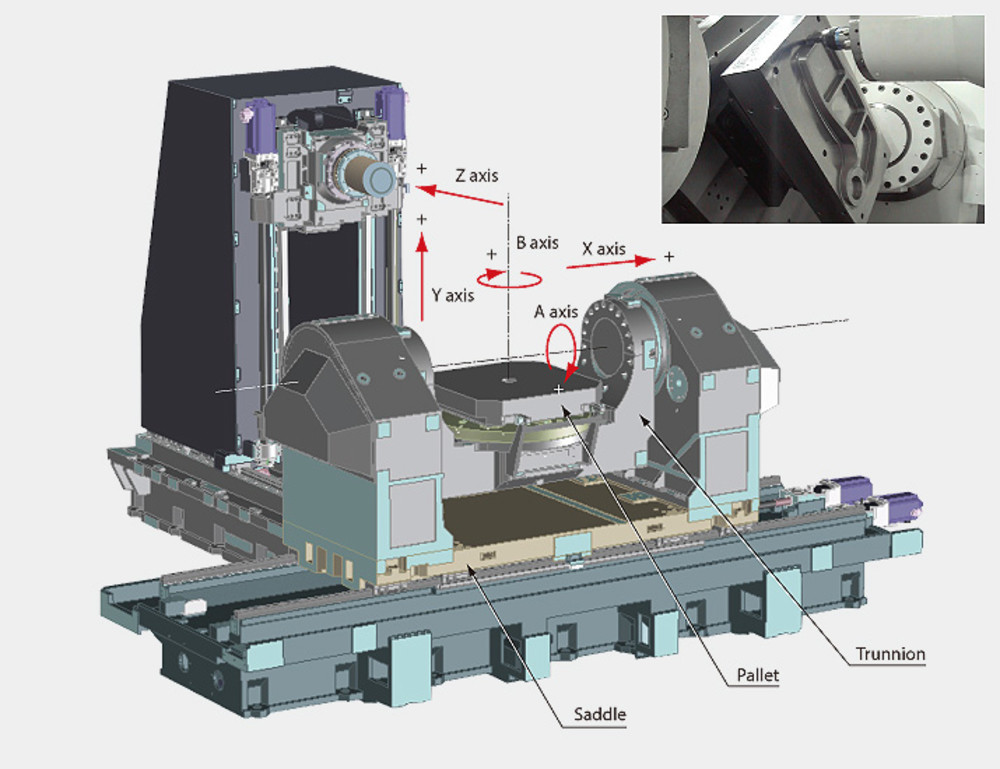
Illustration from [this article](https://www.engineering.com/AdvancedManufacturing/ArticleID/11930/The-What-Why-and-How-of-5-Axis-CNC-Machining.aspx)
The design space of multi-axis path planning is much larger.
Path planning is thus harder, notably because optimization is more likely to get stuck in local extrema.
This implies that the optimization constraints and assumptions have a big impact on the expected solution.
### 3+2-D Path Planning
One strategy is to decouple tool position and orientations, and then iteratively optimize for one while the other one while keeping the other fixed.
* [Sweep scan path planning for efficient freeform surface inspection on five-axis CMM](https://www.sciencedirect.com/science/article/pii/S0010448516300045), Computer-Aided Design 2016
* [Automatic generation of five-axis continuous inspection paths for free-form surfaces](https://ieeexplore.ieee.org/document/7731218/), Transactions on Automation Science and Engineering 2017
### Other
* [CamWorks](https://camworks.com/modules/multiaxismachining/)
* [Cutter-location data optimization in 5-axis surface machining](https://www.sciencedirect.com/science/article/pii/001044859390033K), Computer-Aided Design 1993
* [5-axis Flank Milling](https://www.sciencedirect.com/science/article/pii/S0010448512001728), Computer-Aided Design 2013
* [Improved positioning of cylindrical cutter for flank milling ruled surfaces](https://www.sciencedirect.com/science/article/pii/S0010448504002271), Computer-Aided Design 2005
### Exhaustive Discrete Angle Search
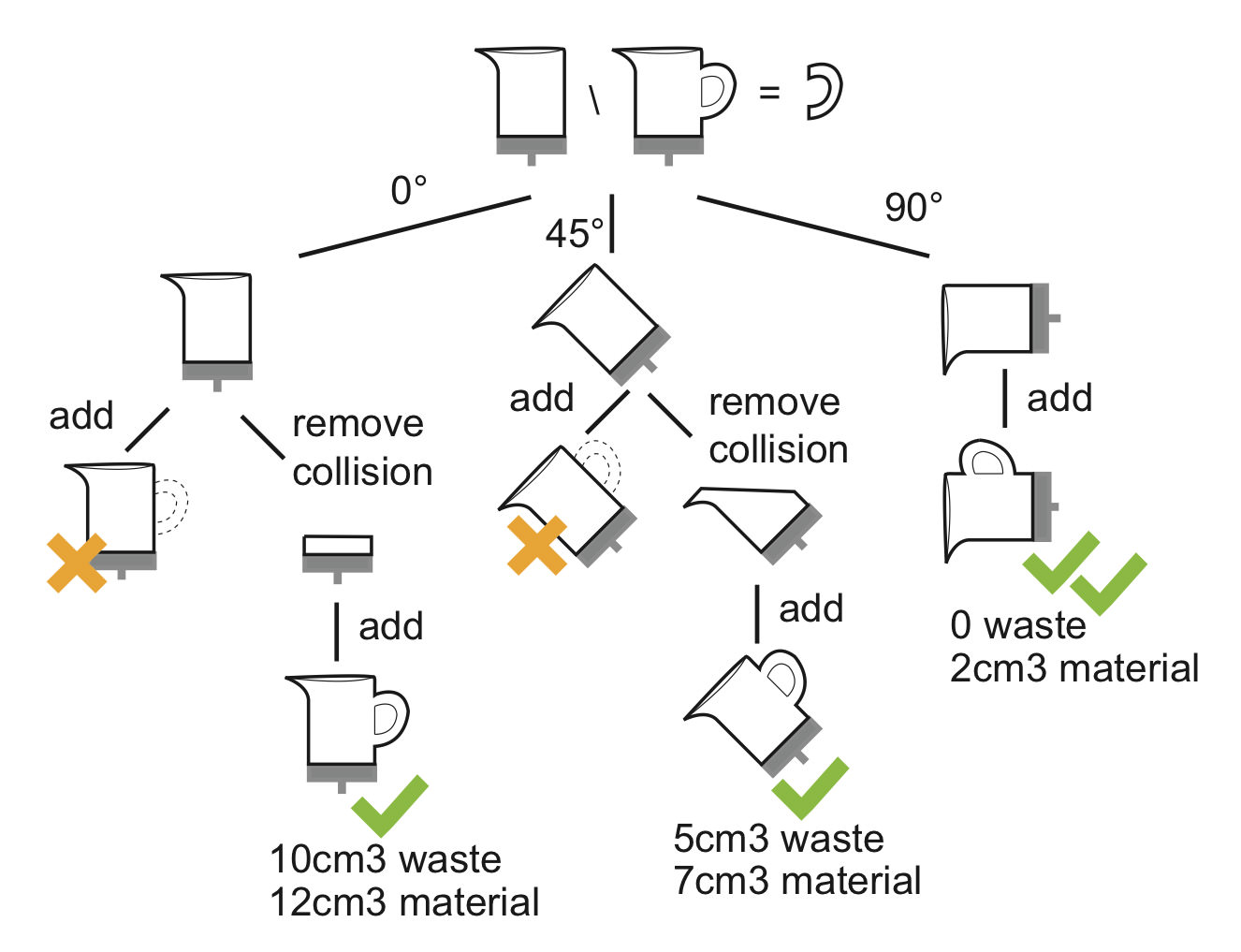
[Patching Physical Objects](http://hcie.csail.mit.edu/research/patching/patching.html)
1. Calculate incremental change
2. Build tree of:
* Calculate collision volume for each potential angle
* Material cost of angle selection (for this layer)
3. Breadth-First Search within tree (as it gets built)