physics of information technology 2022
miana smith
dielectric spectroscopy

05/11 week
Neil says to have drafts of answers to these questions:
- What is your problem?
- what isn't? 😩
- The original(ish) motivation summarized: a common tool in a bio lab is a UV-vis spectrophotometer, such as a NanoDrop, which are used to measure a variety of things, such as DNA/RNA concentration, and optical density (for bacterial growth). Because a Nanodrop machine runs on the order of $10k, and Neil's new VNA is ~$200, can we use dielectric spectroscopy as an approach to measuring some of these quantities instead? There are current applications and research in using dielectric spectroscopy for characterizing ~basically this, so it doesn't seem unreasonable to try.
- Given where I'm at with understanding dielectric spectroscopy (or rather where I'm not), I think a better application to pursue is: Can we do fablab-able dielectric spectroscopy?
- Who's done what on it beforehand?
- I have compiled a lot of background reading, but don't have time to do a write-up before class
- What did you do?
- What's done: So I have the antennas made, I'm trying to figure out how to calibrate the set up. I'm also trying to figure out how to save data??? Also, I guess I'm not that sure about how the antennas are going.
- What's on the horizon: I would like to get the free-space set up working, and try it out on some materials with well known permittivities, and do a more thorough job describing what's going with everything
- How did you do it?
- I guess see below for now?
- What questions did you have to answer?
- What succeeded, and what didn't?
- How is it evaluated?
- What are the implications?
To pick reasonable waveguide dimensions, we should know what wavelengths we'll be sweeping through. For 1GHz: $$ \lambda = \frac{c}{\nu} = \frac{3\times 10^8}{10^9} = 3\times 10^{-1} [m]=300[mm]$$
And for: $$ 3[GHz] \rightarrow 100 [mm] $$

A heuristic for the dimension given by c is to pick a quarter of the wavelength, though [insert link] reference suggests that this is not always ideal. To accomodate for change, the back short wall is adjustable in the physical design.
The dimensions are derived from a commercial antenna etc
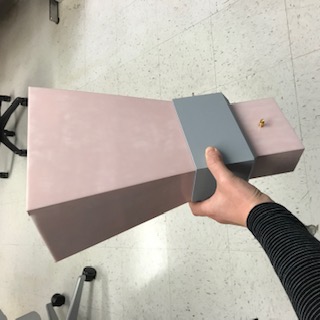
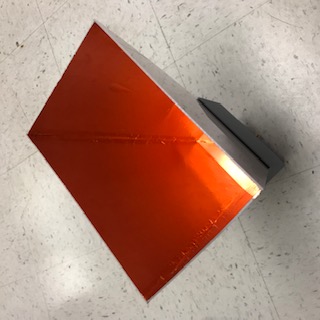
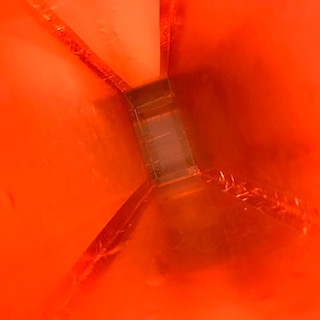
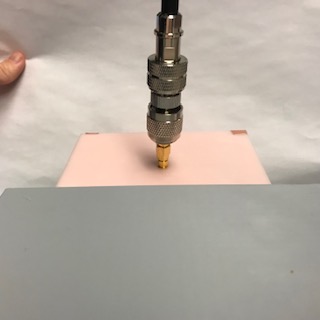
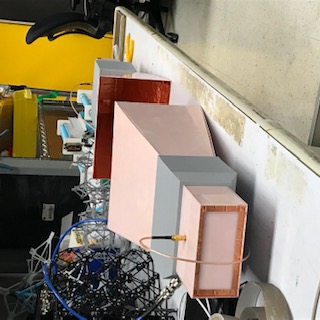
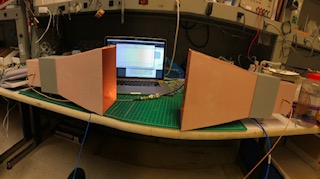
Notes on how this going here
05/03 week
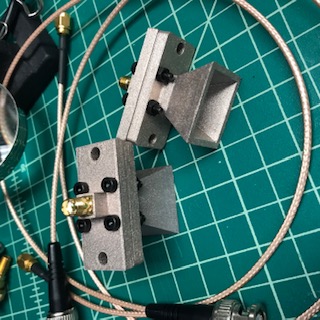
put together the antennas with an inline launch... Learned, or rather, didn't learn somethings: Not sure what's the correct geometry for an inline launch, so I will switch to a right angle one as I can find more resources on it. I've also realized that I've made an antenna for the Ka band (around ~30GHz?) which is a whole order of magnitude than the maximum frequency of Neil's new favorite VNA (don't tell the others). Oopsies! Whodathunkit that the physical dimensions would matter lmao.
04/20 week
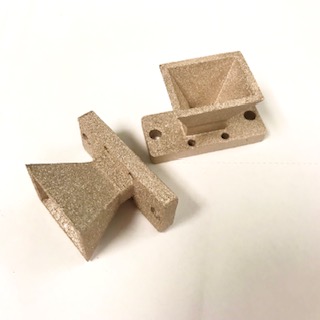
metalized the antennas, very glam. (Sanded down and painted w/ conductive paint). Making a sma launch now with the same method, hopefully it goes well...
04/11 week
Started making the antennas! Got some paint, will test early next week?
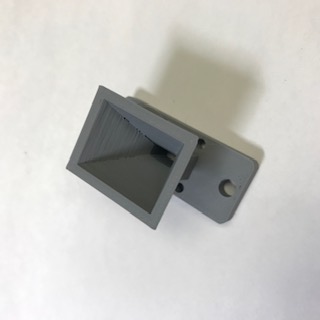
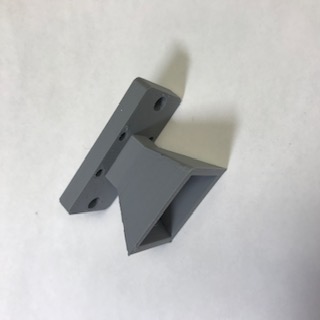
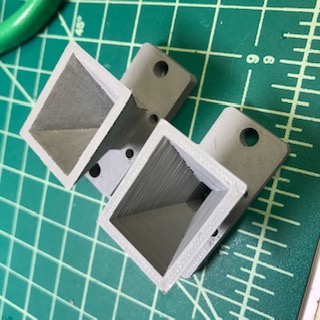
03/28 week
[note from the future: this original plan changed, fyi]
For How to Grow (Almost) Anything, I would like to produce some bio-photovoltaics, similar to what's implemented in this paper. Bio-photovoltaics, and microbial fuel cells more generally, have been of research interest for some time because of their potential as a renewable energy source. However, their industrial and commercial applications still remain limited-to-non-existent in part due to the challenges of efficiently scaling the bio-reactor design, especially as it relates growing autotrophic microbes. A recent-ish paper (Sawa, M., Fantuzzi, A., Bombelli, P. et al. Electricity generation from digitally printed cyanobacteria. Nat Commun 8, 1327 (2017). https://doi.org/10.1038/s41467-017-01084-4) uses inkjet style printing of cyanobacteria as a novel strategy for producing bio-photovoltaics. Extending on the design that they use, I would like to explore producing laminate structures of a durable hydrogel (with and without embedded cyanobacteria) with conductive surfaces, and compare power outputs of various designs.
For this class, I would like to characterize the permittivity of a variety of hydrogels using dielectric spectroscopy.
In the BPV design that I want to explore, a hydrogel (possibly in combination with other material), will act as a dialectric in a parallel plate capacitor. On one plate, the cyanobacteria will cause charge to accumulate during photosynthesis, creating a voltage between the two plates. So, a dielectric with higher permittivity should result in a better performing system.
The other benefit of doing this is that if the BPV stuff fails, I will still have some cool measurements of hydrogels.
So to sum, I will measure the permittivity of a variety of hydrogels (and tbd materials) using dielectric spectroscopy using Neil's new favorite VNA. [LINK?]
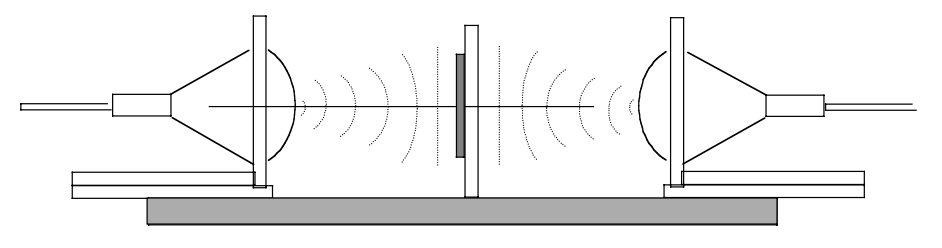
free space measurement diagram
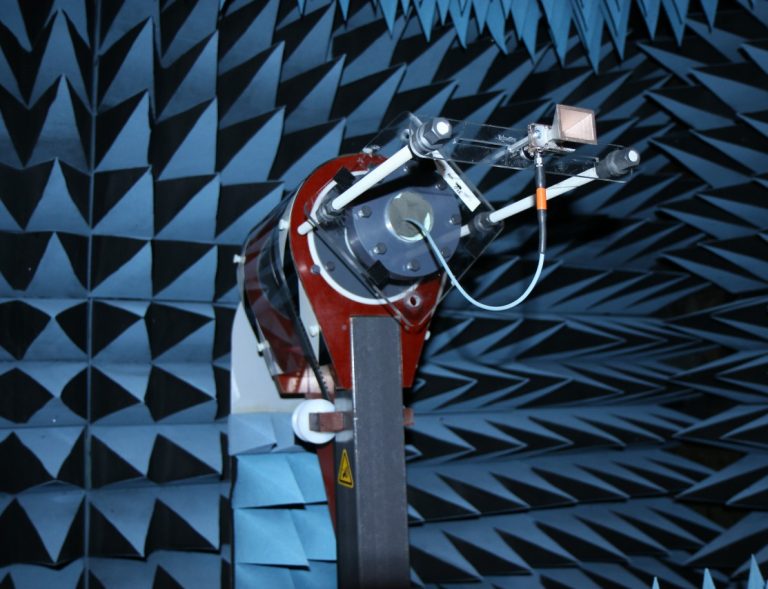
3d printed antenna in anechoic chamber

figure from the paper I'm referencing showing their BPV design
Step 1 will be setting up the experiment.
A diagram of free space measurement dielectric spectroscopy set up from Agilent is shown below.
Agilent has nicely provided two easy to follow resources detailing how to design dielectric spectroscopy experiments for VNAs: Dielectric Spectroscopy (slides), Dielectric Spectroscopy (packet). Though these offer alternate testing configurations, the free-space style configuration appears well suited for my needs. So, we will need some horn antennas! These are quite expensive, but happily, I've found that people have had good results making them via coating 3D prints in metallic paint. This process is well documented here: 3d printed horn antennas. An image of one of their 3D printed antenna tests is shown to the left!
I will start by making some of these antennas, and verifying they work (? how though ?). Then, I will set up the experiment platform (laser cut acrylic for pretty?), and pick out the materials to measure. We will start with calcium alginate at different concentrations, agar at a few concentrations, water, paper, plastic? who's to say. But those are the initial thoughts. The documentation also says that permittivity is related to bacterial content so it could be cool to measure that! Most bacteria concentration measurements are done optically, which can have limitations, e.g. if they're producing pigment or are too concentrated.
