A rectangular plane that rotates along one of its axes creates a cylindrical volume. If the plane is made of a 2D array of addressable LEDs (or any light emissive component) one can render dynamic (shape and color changing) three dimensional elements. The rendered elements are not physically present in space but the added third dimension makes the boundary between the virtual and the physical even finer.
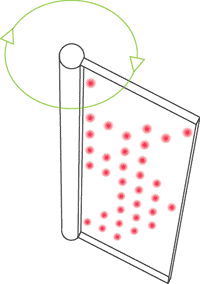
Usage and interaction
Such a device bears many advantages over traditional addressable displays. Appart from the obvious advantage of addressing an extra dimension, one important aspect of it is that it is visible from anywhere in the space surrounding it. It allows people to gather around the display. That could partially address the visibility problem of collaborative tools that use traditional displays. Another advantage over usual 3D (VR) displays is that the users do not need to wear goggles or any other apparatus to view the third dimension.
I find it important to make the display palpable so the users have a sense of physicality when manipulating the rendered object/system. What would happen to the virtual model inside the ball if the user tilts the ball? The same question arises for any hand operation: push, pull, touch, rub, shake, etc.
Implementation
One implementation could be a circular plane that rotates on an axis intersecting its center and parallel to the plane in order to create a spherical volume. The fine tuning of the device is crucial. It must be well balanced and properly encased in a clear ball.
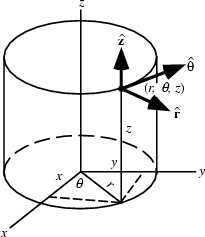
3D virtual models can be rendered by performing a domain transformation from the 3D cartesian coordinate system of the modeling engine to cylindrical coordinates (r, θ, z). This allows an easy mapping to the individual LEDs of the rotating planar display.
The plane must rotate at a speed such that the human eye sees a volume instead of a rotating plane. The eye and brain retain a visual impression for about 1/30th of a second. Therefore 30 rotations per second should be sufficient for persistence of vision to be achieved.