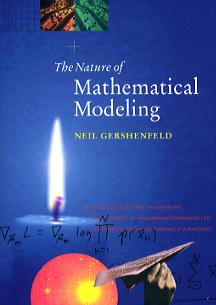
The Nature of Mathematical Modeling
class: Thursdays 1:00-4:00 E14-493
section: Mondays 5:00-6:00 E14-493
Neil Gershenfeld
MAS 864
2026
This course will answer these questions, and many more, through a survey of the range of levels of description for mathematical modeling. The focus will be on understanding how these methods relate, and on how they can be implemented efficiently. Projects based on the class have included data analytics, music synthesis, physics simulation, movie special effects, motion control systems, engineering design optimization, and microelectronics signal processing.
The schedule will be:
| 2/5: | Introduction |
| Mathematical Computing | |
| Linear Algebra and Calculus | |
| Computational Geometry | |
| 2/12: | Differential and Difference Equations |
| Variational Principles | |
| 2/19: | Finite Differences |
| 2/26: | Finite Elements |
| 3/5: | Discrete Elements |
| 3/12: | Random Systems |
| 3/19: | Transforms |
| 3/26: | Spring Break |
| 4/2: | Function Fitting |
| 4/9: | Search |
| 4/16: | Constrained Optimization |
| 4/23: | Neural Networks |
| 4/30: | Machine Learning |
| 5/7: | State and Density Estimation |
| 5/14: | no class |
| 5/15: | final exam |
Relevant background for each of these areas will be covered. The assignments will include problem sets, programming tasks, and a semester modeling project. The course will use an interactive computing revision that is being developed of the text The Nature of Mathematical Modeling.