Final Assignment

12/19/2005

How to Make almostAnything

MAS863 | Fall 2005

 RETURN

Final Project Assignment:

Who's Home!

Personal Internet Zero I0 device/bracelet interface to your home - your neighborhood - the world!

Project:

  • Using IR transmission - transmit personal data via SLIP encoding to the network in your home.

  • As you enter and move about your home, the personal data on your wearable I0 device allows you to interface with your home in many ways:

    • Lighting, HVAC and sound preferences in different rooms tailored to your desires.

    • Know where the kids are playing (or "Who's House" they are playing at) and even what they are up to.

    •  Introduce yourself with your own personal webpage as you enter a neighbors home.


  • More on MAS863 communication:

http://fab.cba.mit.edu/classes/863.05/classes/10_24/

Tasks:

1. Started out trying to transmit I0 using RF, then converted to the IR crowd.  The timing issues associated with the ATMel ATtiny 13 assembly code proved to be the trickiest part of the project.  Starting with Prof. Gershenfeld's IO6&7 boards and code made it a great headstart, however much was to be learned.

2. Ken "Chacha" Avery was the first to get the IR working from week 11 assignment.  His expertise and work he shared was invaluable to what I have done here and I could not have done any of it without Ken's help.  I started with Ken's board designs.  After the board design was tweaked in Eagle, I chose to cut out the boards using the Modela. 

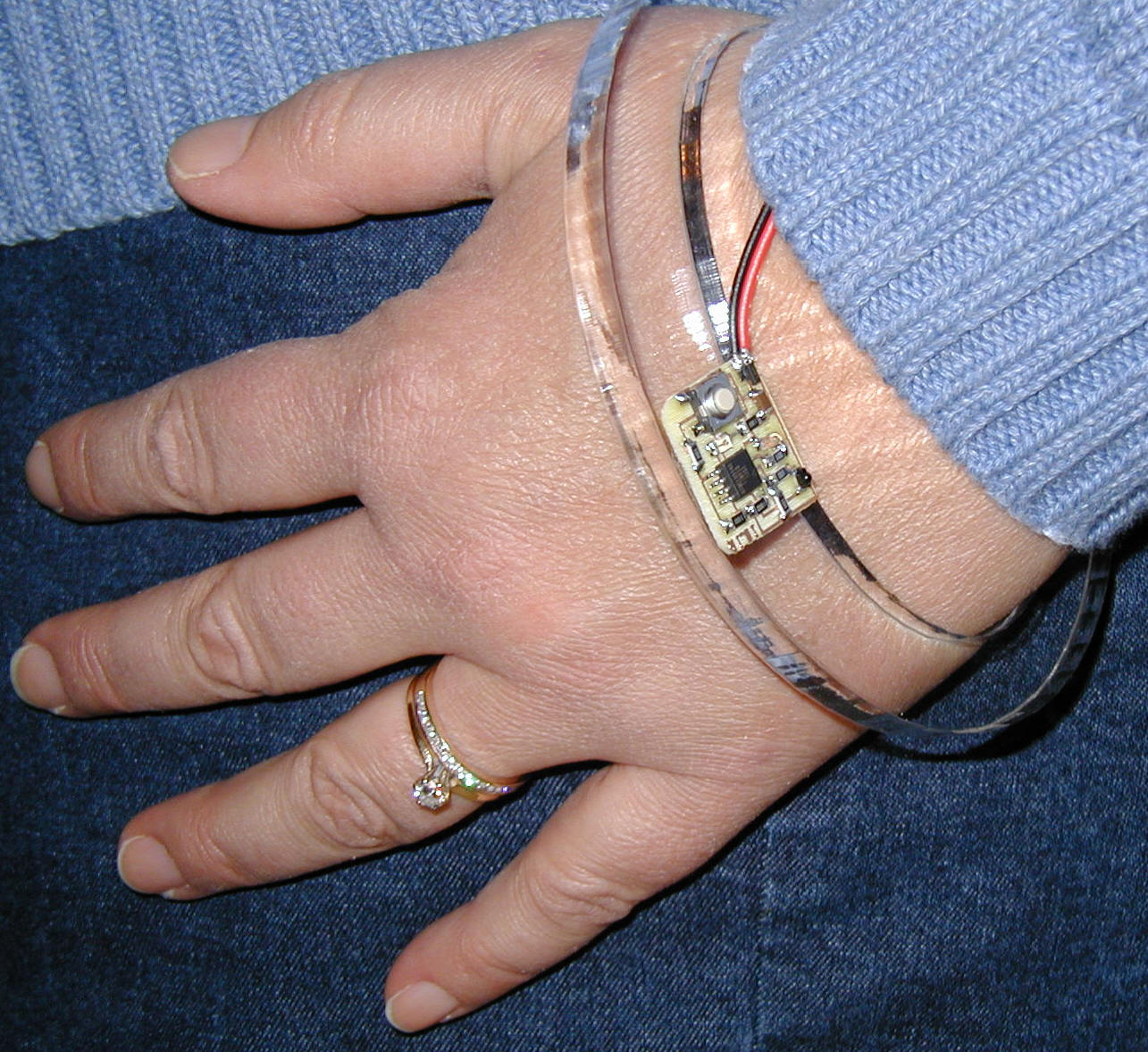
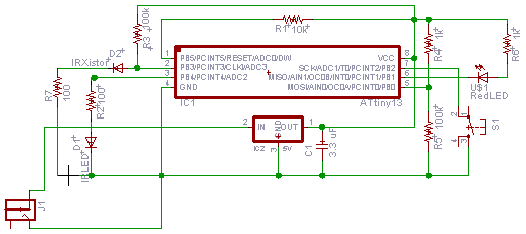
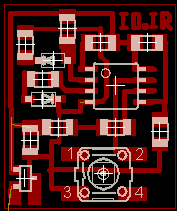
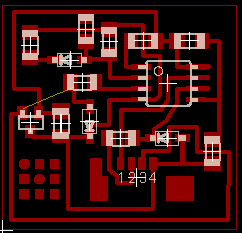
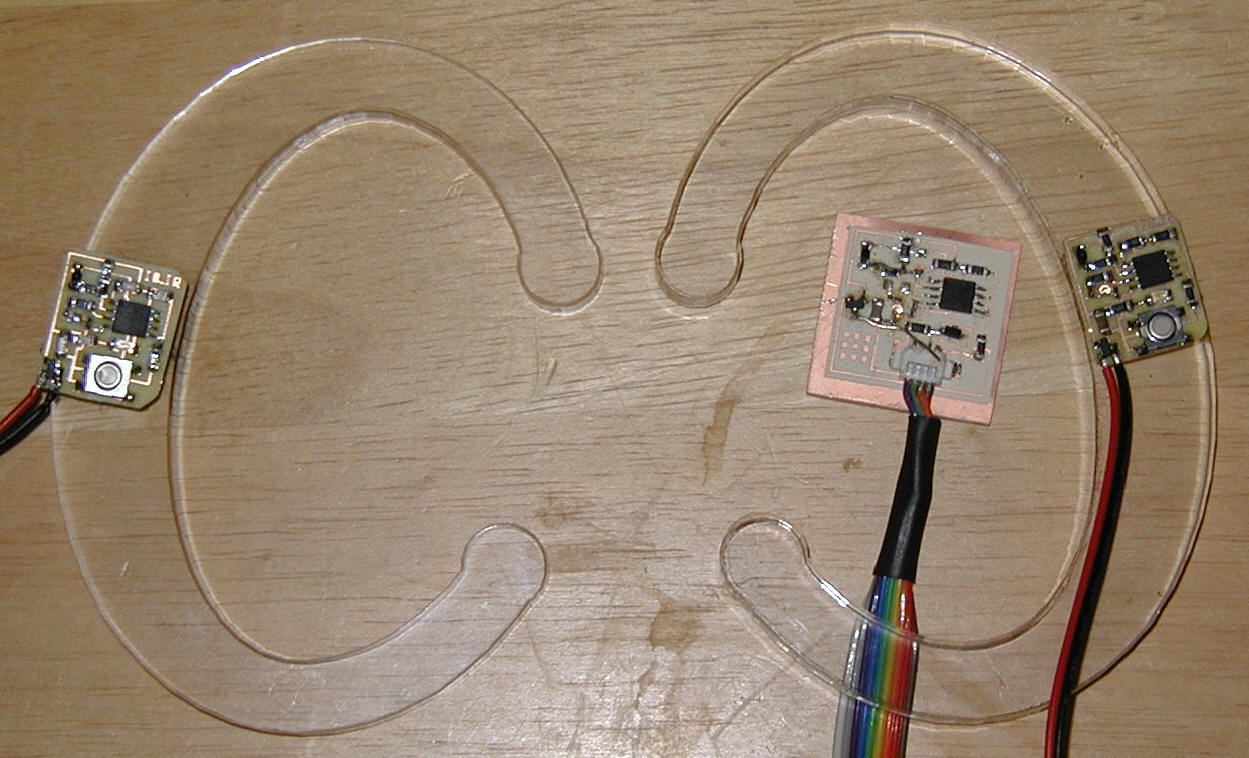
3. Final I06IR board - reduced footprint to fit on bracelet.


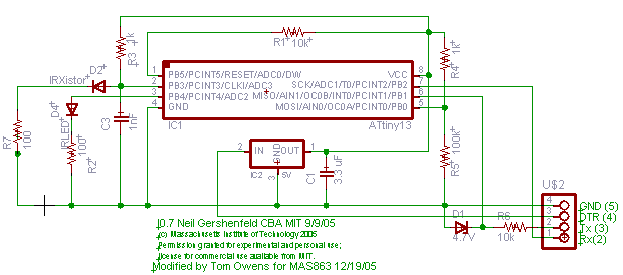
4. Final I07IR board - to be hooked up to the serial port of the computer which would simulate a door jamb in the house.

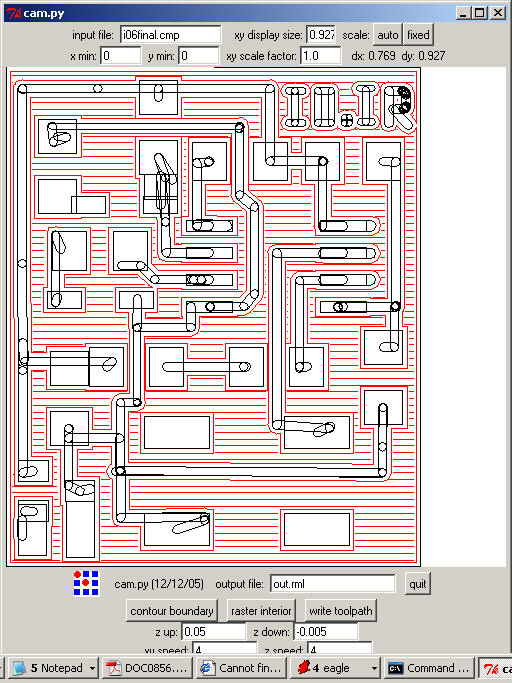
5.  Cam contour and raster of the I06IR board.

6.  The assembly code files:

i06tomold.asm  and testi0.asm

  • The most critical part of getting the boards to talk was the timing loops in the assembly code.  The delays between clicks and bytes set the timing for the I0 bits and bytes.  The timing loops need to be synchronized between the boards as well.

  • Another tricky part about dealing with IR is that the distance is also critical due to intensity of the IR signal at the phototransitor and the triggering of the comparator circuit within the ATtiny13 which is sensing each "click" for each bit.

  • The range for the IR signal between my two boards was approximately between .5cm and 15cm.  The ideal range for proper data throughput is approximately 3cm.

7. The data output using rx.py:


8.Movies of coding process:

9.  Form Factor - bracelets designed in OpenOffice draw and cut on the laser cutter from 3/8" clear acrylic.

bracelet.svg


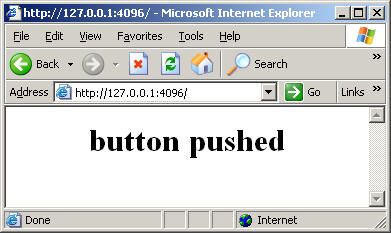
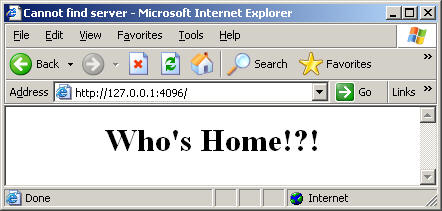
10.  Output while running ththp.py and searching http://127.0.0.1:4096:

Another board more uniquely designed:

  • Note:  In an attempt to redirect the html to another site I ran into trouble with the redirect code, an example follows:

    • <html><meta http-equiv=refresh content=0;url=http://fab.cba.mit.edu></html>

    • The issue I ran into was the redirect code requires a semicolon (just after the '0' above - number of seconds prior to redirect) which signifies a comment in the ATMel assembler.  The escape sequence is &#59; and also requires a semicolon.  So I was stuck at this point unless I coded it into the python program.  Another idea would be to code a semicolon loop to pass the hex 59 at the proper time in the packet, however this would be a very specific application of the technique.  Need some other ideas on this point.

11.  OVERALL RESULTS:

  • The packet is passed successfully about 1 in 3 times due to the sensitivity of the timing and the distance the boards are held apart.  A more robust effort (a few more days!!! or just a good O-scope analysis) at nailing down the timing systems would produce a more consistent result, however, the problems associated with range between the boards (a threshold issue I suspect) may need to be dealt with in the circuit design.


Back To MAS863.05

TOP